High Energy X ray Source
AI + Next Generation of X-Ray Sources
calendar_month
2026-07-31
1. Dynamic Spectral Shaping: Beyond the Fixed Beam
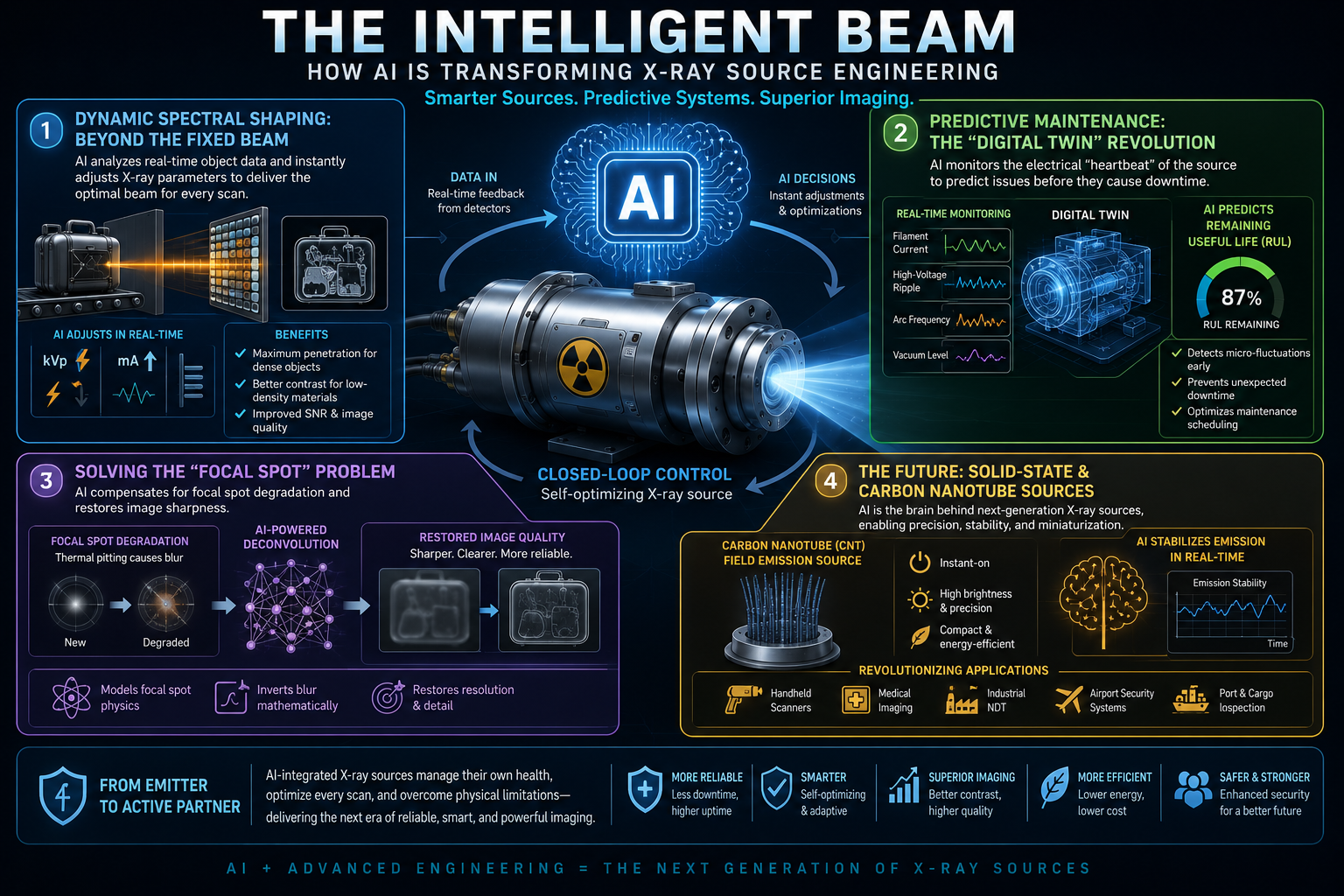
In traditional security and medical imaging, the quality of material discrimination is limited by the "hardness" or "softness" of the X-ray beam. Modern AI is enabling Dynamic Spectral Shaping, where the system acts as a closed-loop controller.
By utilizing real-time feedback from detector arrays, AI algorithms analyze the density profile of an object as it passes through the beam. If the AI detects a high-density metallic object, it can instantaneously command the generator to adjust pulse width or filtration parameters in microseconds. This "on-the-fly" beam modulation ensures maximum penetration for dense cargo while preserving image contrast for lower-density organic materials, effectively minimizing the signal-to-noise ratio (SNR) hurdles that once plagued X-ray physics.
2. Predictive Maintenance: The "Digital Twin" Revolution
Perhaps the most significant industrial impact of AI on X-ray sources is the transition from Preventive to Predictive Maintenance. Through the creation of "Digital Twins"—virtual simulations of the source hardware—AI models monitor the electrical "heartbeat" of the system.
Leading research from institutes like the Pacific Northwest National Laboratory (PNNL) and advancements by manufacturers like Varex Imaging show that AI can detect micro-fluctuations in filament current, high-voltage ripple, and arc frequency long before they cross the threshold into a system-stopping fault. By analyzing these subtle patterns (feature extraction), AI can predict the Remaining Useful Life (RUL) of a cathode or a magnetron, allowing service technicians to perform replacements during scheduled downtime rather than reacting to catastrophic mid-shift failures.
3. Solving the "Focal Spot" Problem
The focal spot size—the point on the anode where electrons strike to produce X-rays—naturally degrades due to thermal pitting (the "wear and tear" of the target material). Traditionally, this meant a loss of image resolution over time.
AI is solving this through computational deconvolution. Instead of simply accepting the "blur" caused by a degraded focal spot, modern reconstruction algorithms treat the focal spot geometry as a dynamic variable. By understanding the specific physics of how a degraded target scatters radiation, the AI mathematically inverts the blur, restoring image sharpness. In advanced LINAC-based systems, AI is even being used to steer the electron beam precisely onto the center of the target, compensating for thermal expansion that would otherwise cause the focal spot to wander.
4. The Future: Solid-State and Carbon Nanotube Sources
The most radical change on the horizon is the move away from traditional, bulky vacuum tubes to Carbon Nanotube (CNT) Field Emission sources. These sources offer the potential for "instant-on" X-ray generation and pulse-level precision that is too complex for human operators or traditional analog circuits to manage.
AI serves as the essential "brain" for these next-generation sources. Because CNT-based emission can be inherently unstable, high-speed AI controllers are required to stabilize the emission in real-time. This synergy between AI and new materials is paving the way for smaller, faster, and more energy-efficient X-ray sources that could eventually revolutionize everything from handheld scanners to massive, high-throughput port security portals.
Conclusion: From Emitter to "Active Partner"
The impact of AI on X-ray sources represents a fundamental evolution: the source is no longer just a passive radiation emitter; it has become an active, intelligent partner in the imaging process. By managing its own health, optimizing its spectral output for every unique scan, and mathematically compensating for its own physical degradation, the AI-integrated X-ray source is enabling a new era of security—one where systems are more reliable, safer, and significantly more capable than their predecessors.
Scientific & Industry References for Further Exploration:
IEEE Xplore (Transactions on Computational Imaging): "Deep Learning for X-ray Source Control."
Elsevier (Journal of Nondestructive Evaluation): "Predictive Maintenance and Reliability in Industrial X-ray Systems."
Nature Electronics: "Advances in Field Emission and Pulsed X-ray Generation."
MIT Technology Review: Reports on "AI-at-the-Edge" and hardware-level machine learning.
In traditional security and medical imaging, the quality of material discrimination is limited by the "hardness" or "softness" of the X-ray beam. Modern AI is enabling Dynamic Spectral Shaping, where the system acts as a closed-loop controller.
By utilizing real-time feedback from detector arrays, AI algorithms analyze the density profile of an object as it passes through the beam. If the AI detects a high-density metallic object, it can instantaneously command the generator to adjust pulse width or filtration parameters in microseconds. This "on-the-fly" beam modulation ensures maximum penetration for dense cargo while preserving image contrast for lower-density organic materials, effectively minimizing the signal-to-noise ratio (SNR) hurdles that once plagued X-ray physics.
2. Predictive Maintenance: The "Digital Twin" Revolution
Perhaps the most significant industrial impact of AI on X-ray sources is the transition from Preventive to Predictive Maintenance. Through the creation of "Digital Twins"—virtual simulations of the source hardware—AI models monitor the electrical "heartbeat" of the system.
Leading research from institutes like the Pacific Northwest National Laboratory (PNNL) and advancements by manufacturers like Varex Imaging show that AI can detect micro-fluctuations in filament current, high-voltage ripple, and arc frequency long before they cross the threshold into a system-stopping fault. By analyzing these subtle patterns (feature extraction), AI can predict the Remaining Useful Life (RUL) of a cathode or a magnetron, allowing service technicians to perform replacements during scheduled downtime rather than reacting to catastrophic mid-shift failures.
3. Solving the "Focal Spot" Problem
The focal spot size—the point on the anode where electrons strike to produce X-rays—naturally degrades due to thermal pitting (the "wear and tear" of the target material). Traditionally, this meant a loss of image resolution over time.
AI is solving this through computational deconvolution. Instead of simply accepting the "blur" caused by a degraded focal spot, modern reconstruction algorithms treat the focal spot geometry as a dynamic variable. By understanding the specific physics of how a degraded target scatters radiation, the AI mathematically inverts the blur, restoring image sharpness. In advanced LINAC-based systems, AI is even being used to steer the electron beam precisely onto the center of the target, compensating for thermal expansion that would otherwise cause the focal spot to wander.
4. The Future: Solid-State and Carbon Nanotube Sources
The most radical change on the horizon is the move away from traditional, bulky vacuum tubes to Carbon Nanotube (CNT) Field Emission sources. These sources offer the potential for "instant-on" X-ray generation and pulse-level precision that is too complex for human operators or traditional analog circuits to manage.
AI serves as the essential "brain" for these next-generation sources. Because CNT-based emission can be inherently unstable, high-speed AI controllers are required to stabilize the emission in real-time. This synergy between AI and new materials is paving the way for smaller, faster, and more energy-efficient X-ray sources that could eventually revolutionize everything from handheld scanners to massive, high-throughput port security portals.
Conclusion: From Emitter to "Active Partner"
The impact of AI on X-ray sources represents a fundamental evolution: the source is no longer just a passive radiation emitter; it has become an active, intelligent partner in the imaging process. By managing its own health, optimizing its spectral output for every unique scan, and mathematically compensating for its own physical degradation, the AI-integrated X-ray source is enabling a new era of security—one where systems are more reliable, safer, and significantly more capable than their predecessors.
Scientific & Industry References for Further Exploration:
IEEE Xplore (Transactions on Computational Imaging): "Deep Learning for X-ray Source Control."
Elsevier (Journal of Nondestructive Evaluation): "Predictive Maintenance and Reliability in Industrial X-ray Systems."
Nature Electronics: "Advances in Field Emission and Pulsed X-ray Generation."
MIT Technology Review: Reports on "AI-at-the-Edge" and hardware-level machine learning.