Inspection Technology
Backscatter vs Transmission X-Ray: Choosing the Right System
calendar_month
2026-07-13
Backscatter vs Transmission X-Ray: Choosing the Right System
By Mohamed Noaman
Two Different Ways of Seeing
Not all X-ray inspection systems work the same way. The two dominant approaches — transmission X-ray and backscatter X-ray — solve different problems, and understanding the difference is essential when selecting the right technology for a given security or inspection application.
Transmission X-Ray
Transmission systems, the type most people picture when they think of an X-ray scanner, pass radiation through an object and capture what comes out the other side on a detector. The image reflects the density and thickness of everything the beam passed through, making it excellent for revealing the internal structure of an object — layers, shapes, and material density all at once. This is the technology behind most baggage and cargo scanners.
Backscatter X-Ray
Backscatter systems work differently: instead of measuring radiation that passes through an object, they measure radiation that reflects back toward the source after striking the surface and near-surface layers. This makes backscatter especially good at detecting organic materials — such as explosives, drugs, or other low-density contraband — that can be difficult to distinguish in a transmission image, and it doesn't require access to both sides of the object being scanned, which matters for vehicles, vessel hulls, or one-sided inspection points.
Choosing Between Them
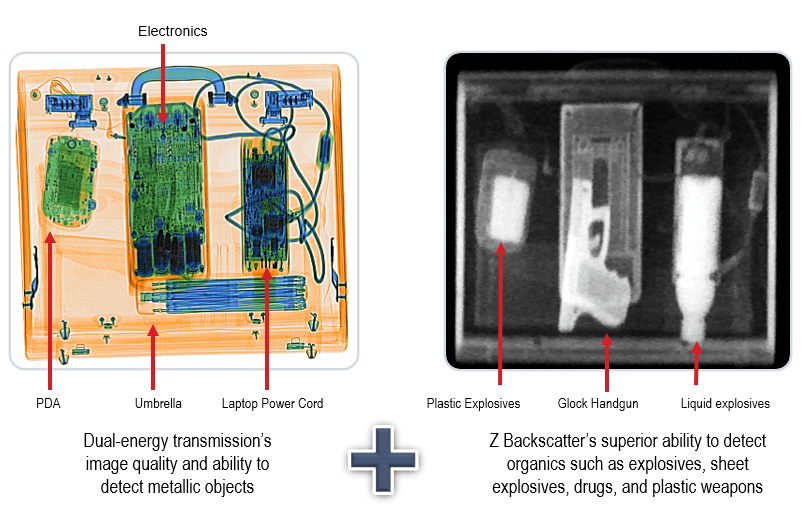
The right choice depends on the inspection goal. Transmission X-ray is generally better suited to understanding what's inside a sealed container or bag layer by layer. Backscatter is often the better tool when the priority is detecting organic threats near the surface, or when only one side of the target is accessible — such as inspecting the underside of a vehicle or the walls of a structure. In many high-security environments, the two technologies are deployed together, giving operators a transmission view for structure and a backscatter view for surface-level organic threats.
Key Takeaway
Neither technology is universally "better" — they answer different questions. Effective system selection starts with defining what you actually need to detect and where the scan needs to happen, then matching the physics to the mission.
By Mohamed Noaman
Two Different Ways of Seeing
Not all X-ray inspection systems work the same way. The two dominant approaches — transmission X-ray and backscatter X-ray — solve different problems, and understanding the difference is essential when selecting the right technology for a given security or inspection application.
Transmission X-Ray
Transmission systems, the type most people picture when they think of an X-ray scanner, pass radiation through an object and capture what comes out the other side on a detector. The image reflects the density and thickness of everything the beam passed through, making it excellent for revealing the internal structure of an object — layers, shapes, and material density all at once. This is the technology behind most baggage and cargo scanners.
Backscatter X-Ray
Backscatter systems work differently: instead of measuring radiation that passes through an object, they measure radiation that reflects back toward the source after striking the surface and near-surface layers. This makes backscatter especially good at detecting organic materials — such as explosives, drugs, or other low-density contraband — that can be difficult to distinguish in a transmission image, and it doesn't require access to both sides of the object being scanned, which matters for vehicles, vessel hulls, or one-sided inspection points.
Choosing Between Them
The right choice depends on the inspection goal. Transmission X-ray is generally better suited to understanding what's inside a sealed container or bag layer by layer. Backscatter is often the better tool when the priority is detecting organic threats near the surface, or when only one side of the target is accessible — such as inspecting the underside of a vehicle or the walls of a structure. In many high-security environments, the two technologies are deployed together, giving operators a transmission view for structure and a backscatter view for surface-level organic threats.
Key Takeaway
Neither technology is universally "better" — they answer different questions. Effective system selection starts with defining what you actually need to detect and where the scan needs to happen, then matching the physics to the mission.