Medical X Ray
Can We Improve the Precision of Cancer Treatment Using Targeted X-Ray Technology?
calendar_month
2026-07-02
Can We Improve the Precision of Cancer Treatment Using Targeted X-Ray Technology?
By Mohamed Noaman
Introduction
Every day, millions of X-ray images are acquired worldwide for medical diagnosis and security inspection. At the same time, high-energy X-ray beams save countless lives through radiotherapy. This raises an important question: can future X-ray technologies become even more precise in selectively destroying cancer cells while preserving healthy tissue?
Understanding the Biology
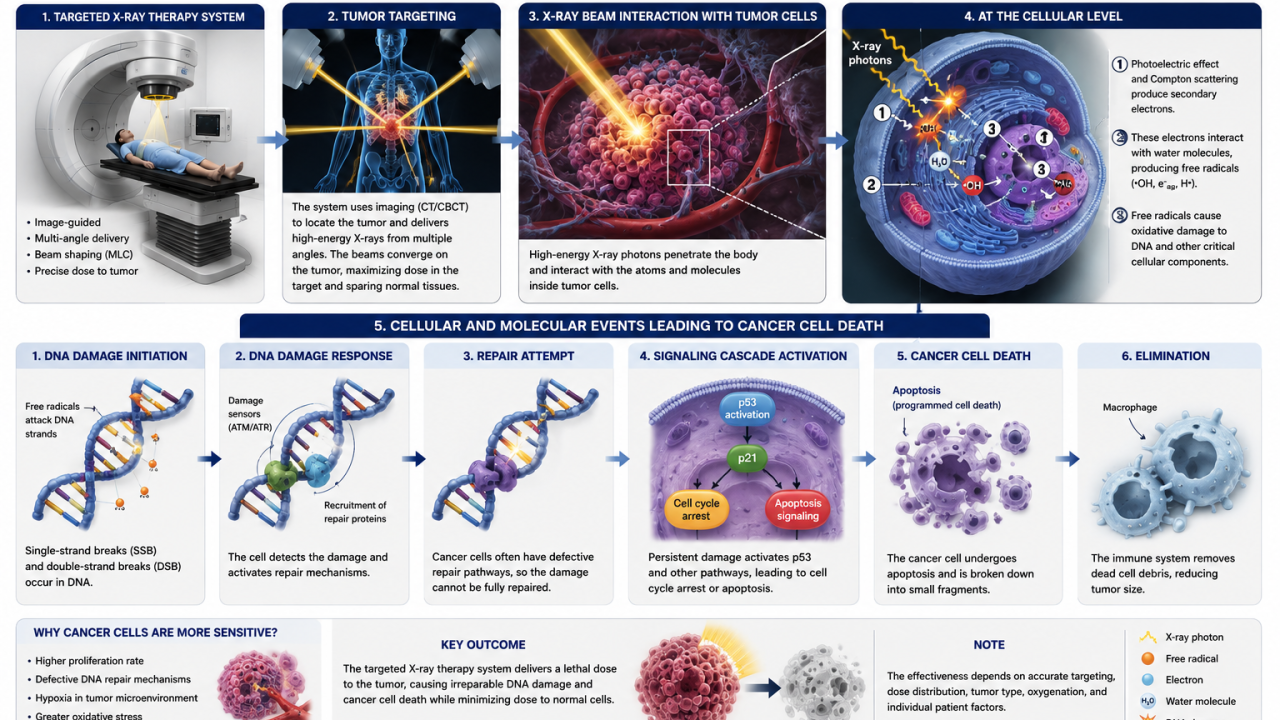
Cancer cells divide rapidly and often carry defective DNA repair mechanisms. When ionizing X-rays interact with biological tissue, they generate energetic secondary electrons that ionize water molecules, producing reactive oxygen species such as hydroxyl radicals (•OH). Together with direct energy deposition, these processes damage DNA. The most critical lesions are double-strand breaks, which can overwhelm a cell's repair machinery and lead to cell-cycle arrest, apoptosis, mitotic catastrophe, or permanent loss of reproductive capacity. Because cancer cells often have weaker repair and checkpoint pathways than healthy cells, they tend to be more vulnerable to this damage — but the challenge has always been delivering that dose with enough precision while minimizing exposure to surrounding healthy tissue.
A Concept Worth Exploring
I'm interested in exploring a conceptual next-generation image-guided, targeted X-ray therapy system — one that could integrate advanced imaging, AI-assisted tumor localization, adaptive beam shaping, real-time treatment verification, and intelligent dose optimization. The goal isn't to increase radiation exposure, but to sharpen targeting precision and maximize the biological effect within the tumor while further reducing dose to surrounding healthy tissue.
Looking Ahead
Turning this concept into practice will require computational modeling, dosimetric validation, laboratory investigation, and eventually clinical evaluation. Innovation begins with the right questions, and progress here will depend on collaboration among medical physicists, radiation oncologists, biomedical engineers, and AI researchers working together.
Keywords
#Radiotherapy #MedicalPhysics #XRay #CancerResearch #BiomedicalEngineering #ArtificialIntelligence #Innovation #Healthcare
https://www.linkedin.com/pulse/can-we-improve-precision-cancer-treatment-using-targeted-noaman-5ufmf
By Mohamed Noaman
Introduction
Every day, millions of X-ray images are acquired worldwide for medical diagnosis and security inspection. At the same time, high-energy X-ray beams save countless lives through radiotherapy. This raises an important question: can future X-ray technologies become even more precise in selectively destroying cancer cells while preserving healthy tissue?
Understanding the Biology
Cancer cells divide rapidly and often carry defective DNA repair mechanisms. When ionizing X-rays interact with biological tissue, they generate energetic secondary electrons that ionize water molecules, producing reactive oxygen species such as hydroxyl radicals (•OH). Together with direct energy deposition, these processes damage DNA. The most critical lesions are double-strand breaks, which can overwhelm a cell's repair machinery and lead to cell-cycle arrest, apoptosis, mitotic catastrophe, or permanent loss of reproductive capacity. Because cancer cells often have weaker repair and checkpoint pathways than healthy cells, they tend to be more vulnerable to this damage — but the challenge has always been delivering that dose with enough precision while minimizing exposure to surrounding healthy tissue.
A Concept Worth Exploring
I'm interested in exploring a conceptual next-generation image-guided, targeted X-ray therapy system — one that could integrate advanced imaging, AI-assisted tumor localization, adaptive beam shaping, real-time treatment verification, and intelligent dose optimization. The goal isn't to increase radiation exposure, but to sharpen targeting precision and maximize the biological effect within the tumor while further reducing dose to surrounding healthy tissue.
Looking Ahead
Turning this concept into practice will require computational modeling, dosimetric validation, laboratory investigation, and eventually clinical evaluation. Innovation begins with the right questions, and progress here will depend on collaboration among medical physicists, radiation oncologists, biomedical engineers, and AI researchers working together.
Keywords
#Radiotherapy #MedicalPhysics #XRay #CancerResearch #BiomedicalEngineering #ArtificialIntelligence #Innovation #Healthcare
https://www.linkedin.com/pulse/can-we-improve-precision-cancer-treatment-using-targeted-noaman-5ufmf