Threat Detection
X-Ray Image Interpretation: Best Practices for Threat Detection
calendar_month
2026-07-13
X-Ray Image Interpretation: Best Practices for Threat Detection
By Mohamed Noaman
The Human Factor
A world-class X-ray scanner is only as good as the person reading its output. Image interpretation is a learned skill, not an intuitive one — and in security screening, the cost of a missed read is measured in real risk, not just a failed inspection.
Know the Baseline
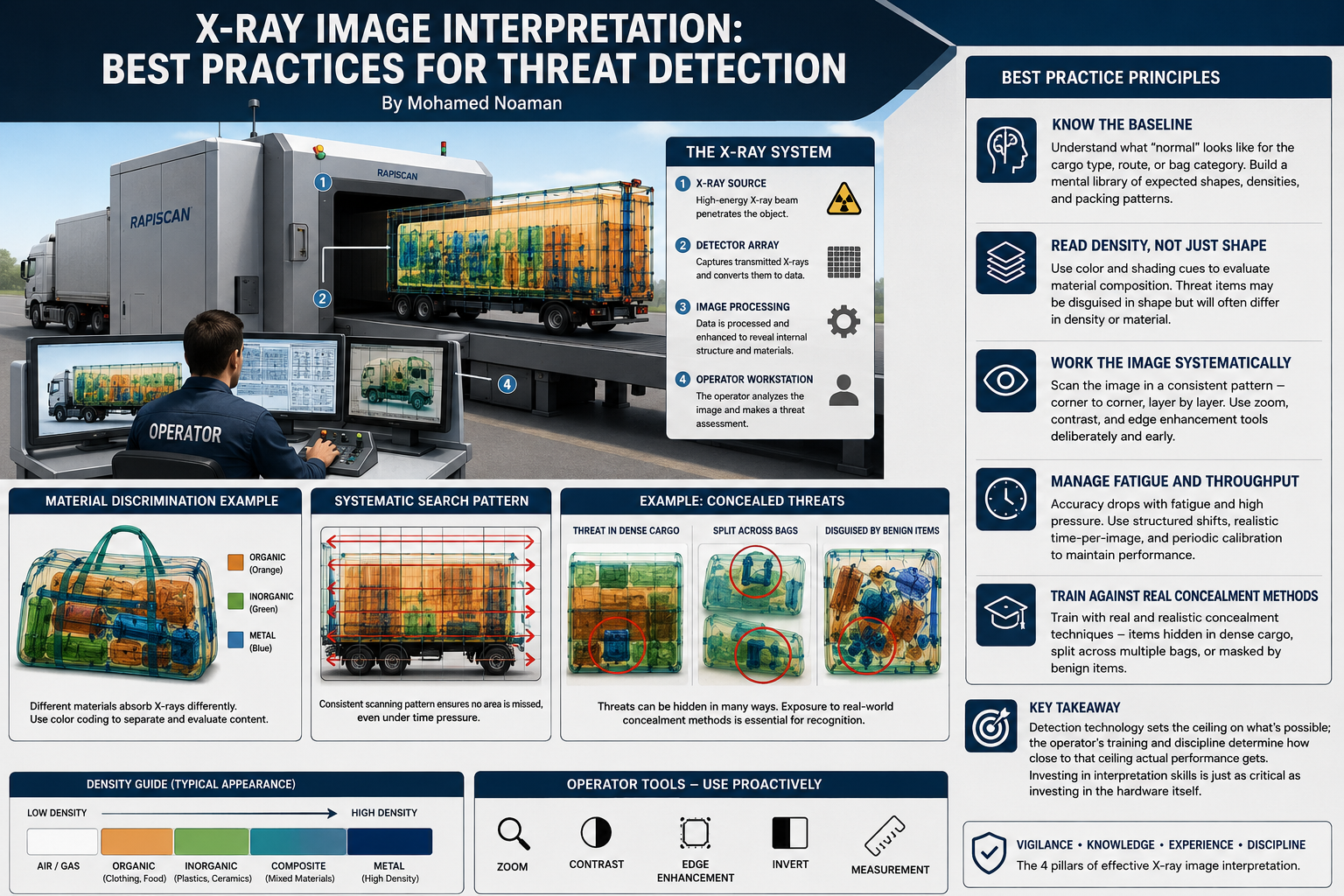
Reliable interpretation starts with knowing what "normal" looks like for a given cargo type, route, or bag category. Operators who see the same categories of shipment repeatedly build a mental library of expected shapes, densities, and packing patterns — which makes it far easier to spot the item that doesn't belong.
Read Density, Not Just Shape
New operators often focus on recognizing shapes — the outline of a weapon, for example. Experienced operators read density and material composition just as closely, using color and shading cues (in systems with material discrimination) to separate organic, inorganic, and metallic content. A threat item deliberately disguised in shape can still stand out by density.
Work the Image Systematically
Rather than scanning an image randomly, trained operators work it in a consistent pattern — corner to corner, layer by layer — so nothing gets skipped under time pressure. Zoom, contrast adjustment, and edge enhancement tools should be used deliberately, not just when something looks suspicious, since some of the most well-concealed threats look unremarkable at first glance.
Manage Fatigue and Throughput
Interpretation accuracy drops measurably with fatigue and high throughput pressure. Structured shift rotations, realistic time-per-image expectations, and periodic recalibration using known test images all help keep detection rates consistent across a full shift, not just at the start of it.
Train Against Real Concealment Methods
The best training programs use image libraries built from real and realistic concealment techniques, not just textbook examples. Recognizing a deliberately obscured item — nested inside dense cargo, or split across multiple bags — requires exposure to those patterns before they show up in a live scan.
Key Takeaway
Detection technology sets the ceiling on what's possible; the operator's training and discipline determine how close to that ceiling actual performance gets. Investing in interpretation skills is just as critical as investing in the hardware itself.
By Mohamed Noaman
The Human Factor
A world-class X-ray scanner is only as good as the person reading its output. Image interpretation is a learned skill, not an intuitive one — and in security screening, the cost of a missed read is measured in real risk, not just a failed inspection.
Know the Baseline
Reliable interpretation starts with knowing what "normal" looks like for a given cargo type, route, or bag category. Operators who see the same categories of shipment repeatedly build a mental library of expected shapes, densities, and packing patterns — which makes it far easier to spot the item that doesn't belong.
Read Density, Not Just Shape
New operators often focus on recognizing shapes — the outline of a weapon, for example. Experienced operators read density and material composition just as closely, using color and shading cues (in systems with material discrimination) to separate organic, inorganic, and metallic content. A threat item deliberately disguised in shape can still stand out by density.
Work the Image Systematically
Rather than scanning an image randomly, trained operators work it in a consistent pattern — corner to corner, layer by layer — so nothing gets skipped under time pressure. Zoom, contrast adjustment, and edge enhancement tools should be used deliberately, not just when something looks suspicious, since some of the most well-concealed threats look unremarkable at first glance.
Manage Fatigue and Throughput
Interpretation accuracy drops measurably with fatigue and high throughput pressure. Structured shift rotations, realistic time-per-image expectations, and periodic recalibration using known test images all help keep detection rates consistent across a full shift, not just at the start of it.
Train Against Real Concealment Methods
The best training programs use image libraries built from real and realistic concealment techniques, not just textbook examples. Recognizing a deliberately obscured item — nested inside dense cargo, or split across multiple bags — requires exposure to those patterns before they show up in a live scan.
Key Takeaway
Detection technology sets the ceiling on what's possible; the operator's training and discipline determine how close to that ceiling actual performance gets. Investing in interpretation skills is just as critical as investing in the hardware itself.